
Table of Contents
Most fundraising advice starts from the wrong place.
It assumes you need capital before you have customers. It assumes investors are your first call, not your last. It assumes that raising money is the milestone when really, revenue is.
The startup booted fundraising strategy flips this entirely. It is the approach that the most resilient founders in 2026 are quietly using to build real businesses generating revenue first, building traction on their own terms, and only raising capital when it amplifies an already-working engine rather than compensating for a broken one.
This guide walks through exactly what the strategy is, the five principles that drive it, the metrics that prove it is working, and when to transition from bootstrapped growth into a traditional funding round.
What Is a Startup Booted Fundraising Strategy?
A startup booted fundraising strategy is a founder-led approach that prioritizes revenue generation, lean operations, and customer traction before or instead of pursuing external venture capital.
In plain terms: you build and prove the business first. You raise capital second, from a position of leverage rather than desperation.
This is fundamentally different from the traditional VC model, which asks founders to raise money before they have customers and scale aggressively before they have proof.
| Dimension | Booted Strategy | Traditional VC Model |
|---|---|---|
| First priority | Revenue and customers | Capital and headcount |
| Equity position | Founders retain control | Dilution starts early |
| Growth pace | Revenue-validated | Investor-timeline driven |
| Negotiating position | Strong traction proven | Weak unproven idea |
| Risk profile | Low burn, sustainable | High burn, dependent on next round |
| Failure mode | Slow growth | Cash runs out before product-market fit |
The booted strategy does not mean you will never raise capital. It means when you do raise, you raise on your own terms — with real metrics, real customers, and real leverage.
Why Booted Fundraising Is Winning in 2026
The funding environment has shifted dramatically and permanently.
57 percent of founders say fundraising is harder in 2026 than it was last year. To raise even a modest $3 to $4 million seed round, the average founder must contact more than 200 investors, survive 60 or more first meetings, and convert just one or two term sheets if they are lucky.
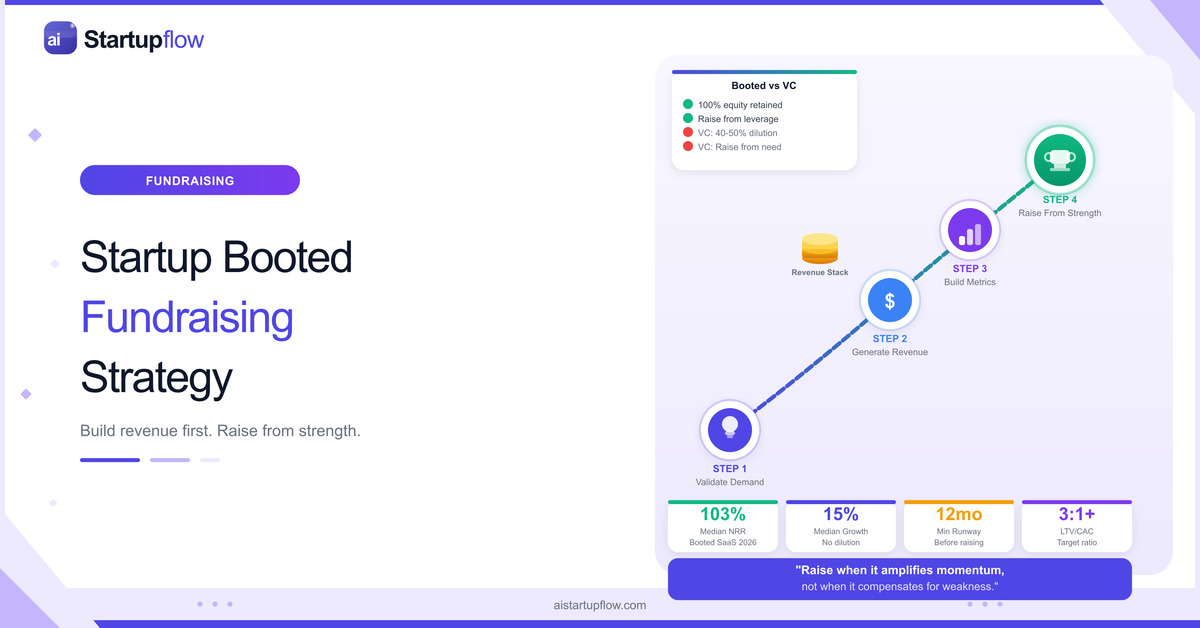
At the same time, bootstrapped companies are quietly outperforming their VC-backed peers on the metrics that actually matter. According to SaaS Capital’s 2026 annual survey of more than 1,000 private B2B SaaS companies, bootstrapped companies with $3M to $20M in ARR maintained a median 15 percent growth rate — with a Net Revenue Retention of 103 percent, meaning existing customers are expanding faster than they churn.
The math is simple. A bootstrapped founder who reaches $5M ARR owns 100 percent of a $5M ARR business. A VC-backed founder who reaches the same number after two funding rounds may own 40 to 50 percent of it and still owes investors a 10x return.
The founders winning in 2026 are not the ones who raised the most money. They are the ones who built the most defensible businesses before anyone wrote them a check.
The 5 Core Principles of a Startup Booted Fundraising Strategy
1. Validate Demand Before Spending
The most expensive mistake a bootstrapped founder can make is building something nobody pays for. Before writing a line of code or hiring your first employee, validate that real customers will exchange real money for your solution.
This means pre-selling charging customers before the product is fully built. It means running manual processes before automating them. It means getting ten paying customers before building for a thousand.
Validation is not a survey. It is not a waitlist. It is a credit card transaction.
2. Generate Revenue From Day One
Every week without revenue is a week burning your personal runway. The booted strategy demands a relentless focus on getting paid not on perfecting the product, not on building the brand, not on optimizing the funnel.
Your first dollar of revenue is more valuable than any investor meeting. It proves the model is real. It funds the next iteration. And it gives you negotiating power that no pitch deck can replicate.
If your business cannot generate any revenue in the first 30 to 60 days, that is a signal worth taking seriously — either the pricing model needs rethinking or the problem is not urgent enough for customers to pay now.
3. Reinvest Revenue With Precision
Bootstrapped growth compounds but only if you reinvest strategically. Every dollar of profit should either reduce your biggest growth constraint or build a system that generates more revenue without more founder time.
The discipline is in prioritization. Do not spend on hiring until revenue cannot grow without it. Do not spend on marketing until your conversion rate is proven. Do not spend on tools until the manual process is validated.
Precision reinvestment is what separates bootstrapped companies that compound from those that plateau.
4. Build Lean Operations
A booted startup’s greatest competitive advantage is its cost structure. When your monthly burn rate is $5,000 and a VC-backed competitor is burning $200,000, you can outlast them through almost any market condition.
Lean operations mean: remote-first teams, AI tools instead of headcount, annual software contracts over monthly, and contractors before full-time employees. Every fixed cost you avoid is runway you keep.
Our guide on the best AI tools for startups in 2026 covers exactly which tools help bootstrapped founders operate leanest — replacing hours of manual work at a fraction of the cost of hiring.
5. Raise From Strength, Not Desperation
If and when you decide to raise external capital, the booted strategy gives you something most founders never have: leverage.
When you walk into an investor meeting with $500K in ARR, 15 percent month-over-month growth, and a CAC payback period under six months, the conversation changes completely. You are not asking for permission to build. You are offering investors a seat on a moving train.
Raise when opportunity outstrips cash flow — to capture market windows or hire talent. Lead investor conversations with metrics: MRR growth, CAC to LTV, margins, retention, and revenue per employee. Select capital that preserves ownership and efficiency.
The Exact Metrics That Prove Your Booted Strategy Is Working
These are the numbers that tell you and eventually your investors — that the booted strategy is producing a real, fundable business.
Monthly Recurring Revenue (MRR) Growth Rate Target 10 to 15 percent month-over-month at early stage. Consistent MRR growth is the single most compelling signal for any investor evaluating a bootstrapped SaaS company.
CAC to LTV Ratio Your Customer Acquisition Cost should be at least 3x less than your Lifetime Value. A ratio of 5:1 or higher is considered excellent and makes the case that more capital into acquisition will compound cleanly.
Gross Margin Software businesses should target 70 percent gross margin or higher. Anything below 50 percent signals either pricing problems or cost structure issues that need to be solved before raising.
Net Revenue Retention (NRR) NRR above 100 percent means your existing customers are expanding faster than they churn. This single metric tells investors the business model is healthy without any new customer acquisition.
Monthly Burn Rate and Runway Keep runway above 12 months at all times. Approaching investors with less than six months of runway is the definition of raising from weakness — it shifts all negotiating power to the investor.
Revenue Per Employee For a lean booted startup, target $200,000 or more in annual revenue per employee. This signals operational efficiency that VC-backed competitors cannot match.
For a detailed breakdown of how to build and track these metrics, our guide on startup booted financial modeling walks through the full process.
When NOT to Use a Booted Strategy
The booted fundraising strategy is powerful but it is not right for every business.
Hardware and physical products require capital before revenue almost by definition. Manufacturing minimums, supply chain setup, and physical inventory create upfront costs that revenue cannot fund fast enough.
Biotech, pharmaceuticals, and deep tech have regulatory timelines that prevent revenue generation for years. Clinical trials, FDA approval processes, and research and development cycles make the revenue-first model structurally impossible.
Winner-take-all markets with network effects sometimes require scale before monetization. If the only way to win your market is to be the biggest player before anyone else gets there and your window is 18 months raising aggressively may be the only viable strategy.
The honest test: Can your business generate $10,000 in monthly revenue within six months using only founder time and under $10,000 in startup costs? If yes, the booted strategy is almost certainly the right starting point. If no — by design, not by effort then external capital may be structurally necessary.
How to Transition From Booted to Funded
Most booted founders eventually face a decision: keep growing organically, or bring in outside capital to accelerate. Here is how to make that transition without losing the leverage the booted strategy built.
Know your raise trigger. Define in advance what metric or milestone justifies raising. Common triggers: you have more qualified leads than you can close, a key hire would 3x growth but cannot be funded by current revenue, or a market window is closing faster than organic growth can capture it.
Build your investor list before you need it. The worst time to start meeting investors is when you need money. Start attending founder events, publishing content, and connecting with angels 6 to 12 months before you plan to raise. Relationships built from strength produce the best terms.
Lead with metrics, not vision. Your pitch is not “here is our vision” it is “here is what we have already built, here is the unit economics, here is exactly where more capital goes and what it returns.”
Preserve optionality. Consider revenue-based financing, strategic angels, or venture debt before taking a traditional priced equity round. These instruments let you access growth capital without the dilution and control dynamics of a standard VC relationship.
Never raise from below six months of runway. If you are approaching investors with less than six months left, you have already lost most of your negotiating position. The booted discipline means maintaining enough runway that you can walk away from any term sheet that does not serve your business.
Frequently Asked Questions
What is a startup booted fundraising strategy?
It is an approach where founders build revenue and traction first using personal resources and early customer income before pursuing or relying on external venture capital.
Does a booted strategy mean I will never raise money?
No. It means you raise on your terms, backed by real metrics, from a position of leverage rather than desperation.
What metrics do investors want to see from a booted startup?
MRR growth rate, CAC to LTV ratio, gross margin, net revenue retention, and monthly burn rate. A booted startup with strong unit economics is a far more compelling investment than an unfunded idea.
How long should I bootstrap before raising?
Until you have enough traction to raise from strength typically $500K to $1M ARR for SaaS, or clear proof of repeatable unit economics. The timeline matters less than the milestone.
Is the booted strategy only for SaaS startups?
No, but it is most naturally suited to software, digital services, consulting, and any business where revenue can precede significant capital expenditure. Hardware, biotech, and deep tech often require external capital by design.
Conclusion
The startup booted fundraising strategy is not a consolation prize for founders who could not raise. It is a deliberate choice made by founders who understand that traction is the best negotiating tool ever built.
Build the revenue first. Prove the model. Keep the equity. Then, when the time is right, raise from strength, not from need.
Ready to build the financial foundation your booted strategy runs on?
Read our complete guide: Startup Booted Financial Modeling: A Complete Founder’s Guide