
Table of Contents
Most startup founders think financial modeling is something you do for investors. Build a pitch deck, attach a spreadsheet, raise money, repeat.
But if you are building without outside capital funding your startup from your own revenue that mindset will get you killed.
Startup booted financial modeling is a completely different discipline. It is not about impressing investors. It is about surviving, staying cash-positive, and growing without giving away equity or running out of money before your business reaches sustainability.
This guide covers everything: what it means, why it matters in 2026, how to build one step by step with real numbers, and which AI tools make the process faster than ever before.
What Is Startup Booted Financial Modeling?
Startup booted financial modeling is the practice of forecasting your startup’s revenue, expenses, and cash flow using only internally generated income no venture capital, no outside investors, no bridge rounds.
The word “booted” is shorthand for “bootstrapped.” A booted startup funds itself entirely through customer revenue. Its financial model reflects that reality: every projection, every spending decision, and every growth plan is grounded in what the business actually earns.
This is fundamentally different from a VC-funded financial model, which assumes future capital injections will cover the gap between current spending and current revenue.
Booted vs. VC-Funded Financial Model
| Dimension | Startup Booted Model | VC-Funded Model |
|---|---|---|
| Revenue assumption | Revenue funds all operations | Future funding covers the gap |
| Growth style | Conservative, revenue-validated | Aggressive, market-share-first |
| Risk tolerance | Low — cash survival is priority | High — losses accepted for growth |
| Key metrics | Runway, burn rate, gross margin | ARR, user growth, TAM |
| Failure mode | Running out of cash before break-even | Burning capital before product-market fit |
Real companies that scaled using bootstrapped financial discipline include Mailchimp, Basecamp, and Canva in its early years — all of which reached profitability before ever touching venture capital.
Why Startup Booted Financial Modeling Matters in 2026
Three things make this more important now than ever before.
Cash flow kills startups faster than anything else. The vast majority of startup failures are not product failures — they are cash failures. The product works, customers exist, but the founder ran out of money before the business became self-sustaining. A booted financial model forces you to see this coming months before it happens.
Equity is expensive. Every round of outside funding reduces your ownership stake permanently. By building a model that funds growth through revenue, you retain full control of your business and every strategic decision inside it. According to Crunchbase, global venture funding fell significantly over recent years pushing thousands of founders toward bootstrapped growth models.
AI tools have changed the math. In 2026, a solo founder with the right AI tools can build financial models, run scenario analyses, and update projections in a fraction of the time it used to take. The barrier to building a serious booted financial model is lower than it has ever been — which means there is no excuse not to have one. We cover the best AI tools for this later in the guide, but if you want the full picture on AI tools for your startup, our breakdown of the top AI tools for startups in 2026 is a strong place to start.
The 5 Core Pillars of a Startup Booted Financial Model
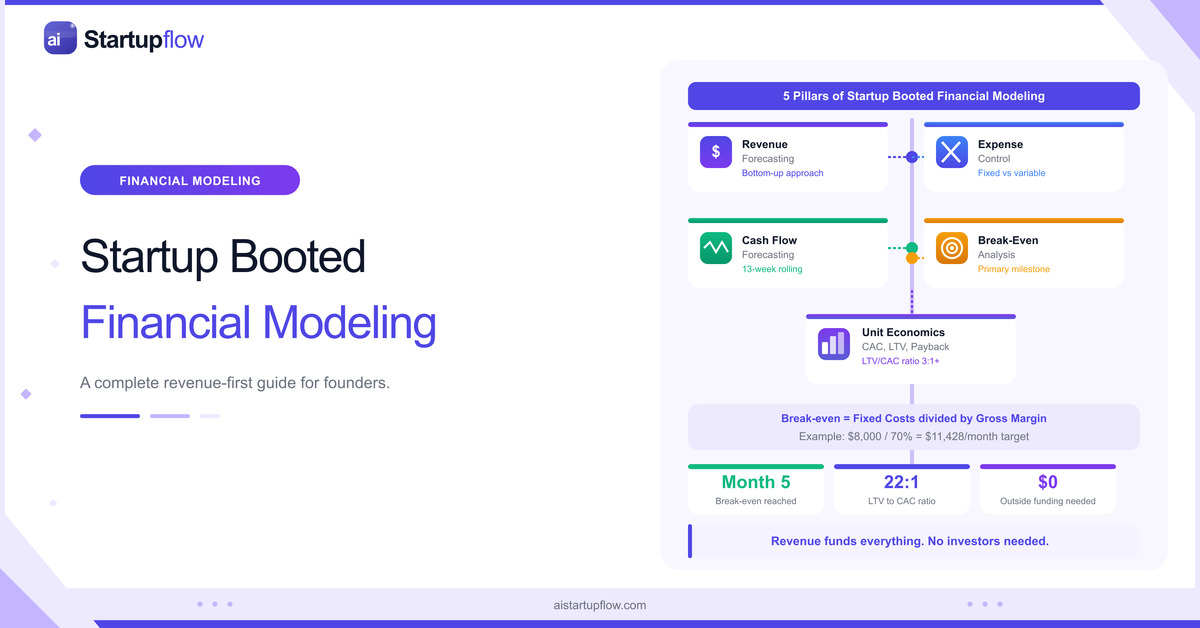
Every strong startup booted financial model is built on five pillars. Skip one and the whole model becomes unreliable.
1. Revenue Forecasting From Real Numbers
Never start with a percentage of a market. Start with what you actually know.
A SaaS founder with 15 paying customers at $200/month has $3,000 MRR. That is your base. From there, you project forward using your actual monthly acquisition rate — not hopes. If you are adding 5 customers per month at $200 each, your model shows $1,000 in new MRR monthly. That is a real, defensible projection.
Bottom-up forecasting is the method: website traffic multiplied by conversion rate multiplied by average purchase value. Each variable is something you can measure and improve independently.
2. Controlled Expense Growth
Bootstrapped startups minimize fixed costs aggressively. Every new expense must be justified by a corresponding revenue impact.
Split your costs into two buckets: fixed (rent, software subscriptions, salaries) and variable (ad spend, contractor fees, commissions). Your booted model should show that variable costs scale only when revenue supports them — never ahead of it.
3. Cash Flow Forecasting
Revenue is vanity. Cash is survival.
Your cash flow forecast tracks the exact timing of money in and money out — week by week, then month by month. A business can be profitable on paper and still run out of cash if customers pay late or expenses hit early. Most founders who run into cash problems saw the warning signs in their cash flow data weeks before the crisis — they just were not looking.
Update your 13-week rolling cash flow forecast every Monday. It is the most important habit in bootstrapped financial management.
4. Break-Even Analysis
Break-even is the point where your monthly revenue exactly covers your monthly operating costs. For a bootstrapped startup, reaching break-even is more important than any other milestone — more important than user growth numbers, more important than press coverage, more important than product launches.
Break-even formula: Break-even revenue = Fixed Costs divided by Gross Margin Percentage
If your fixed costs are $8,000/month and your gross margin is 70%, your break-even revenue is $11,428/month. That is the number your model should be driving toward every single month.
5. Unit Economics: CAC, LTV, and Payback Period
Unit economics tell you whether your business model is actually sustainable at scale.
- CAC (Customer Acquisition Cost): Total sales and marketing spend divided by number of new customers acquired
- LTV (Lifetime Value): Average revenue per customer multiplied by average customer lifespan
- Payback Period: How many months it takes to recover your CAC from a single customer’s gross profit
A healthy booted startup targets an LTV-to-CAC ratio of at least 3:1 and a payback period under 12 months. If your payback period is 18 months and you are funding growth from revenue alone, you are constantly cash-constrained even when the business is growing.
How to Build Your Startup Booted Financial Model (Step by Step)
You do not need accounting software or a finance degree. Google Sheets and honest numbers are enough.
Step 1 – Define Your Revenue Streams
List every way your business earns money. For each stream, define: the number of customers, the average price, and the billing frequency. Keep it simple — one or two revenue streams maximum for early-stage founders.
Step 2 – Build Your Expense Structure
List every fixed cost (things you pay regardless of revenue) and every variable cost (things that scale with sales). Be honest. Most founders underestimate expenses by 20 to 30 percent in their first model.
Step 3 – Create Your Cash Flow Forecast
Build a month-by-month table: opening cash balance, cash in (from revenue), cash out (from expenses), and closing cash balance. Do this for 18 months. The closing balance each month tells you exactly how much runway you have.
Step 4 – Calculate Runway and Break-Even
Runway = Current Cash Balance divided by Monthly Burn Rate
If you have $60,000 in the bank and your burn rate is $8,000/month, your runway is 7.5 months. That is how long you have to reach break-even or find additional revenue before the business runs out of money.
Step 5 – Run Three Scenarios
Never build one projection. Build three:
Base case: Your honest, realistic projection
Best case: Everything performs 20 to 30 percent better than expected
Worst case: Growth is 30 to 40 percent slower and a major customer churns
The worst case scenario is the one that matters most. If your startup survives the worst case with at least three months of runway remaining, your model is solid.
Real Example SaaS Startup Booted Financial Model
Here is a concrete worked example with real numbers.
Startup profile: Solo founder, B2B SaaS tool, $99/month subscription
Month 1 baseline:
Customers: 20
MRR: $1,980
Fixed costs: $2,400 (software, hosting, tools)
Variable costs: $400 (ads)
Net cash flow: -$820
Cash in bank: $15,000
Runway: 18 months
Month 6 projection (adding 8 customers/month, 3% churn):
Customers: 60
MRR: $5,940
Fixed costs: $2,800 (one new tool added)
Variable costs: $900 (increased ad spend)
Net cash flow: +$2,240
Cumulative cash: $19,500
Status: Cash flow positive
Month 12 projection:
Customers: 105
MRR: $10,395
Fixed costs: $4,200 (part-time contractor added)
Variable costs: $1,500
Net cash flow: +$4,695
Break-even: Crossed at Month 5
LTV at 3% monthly churn: ~$3,300 per customer
CAC at current ad spend: $150
LTV/CAC ratio: 22:1 — extremely healthy
This is what a real booted financial model looks like when it works. Every number is traceable to a real business decision.
AI Tools That Make Startup Booted Financial Modeling Easier
In 2026, the right AI tools can cut your modeling time from days to hours. Here are the four that matter most for bootstrapped founders.
ChatGPT or Claude — Use these to generate your first financial model structure, write formulas, explain accounting concepts, and stress-test your assumptions by asking “what if” questions in plain English. Prompt: “Build me a 12-month SaaS cash flow model with 5% monthly customer growth and 3% churn starting from $3,000 MRR.”
Google Sheets — Still the best tool for actually building and maintaining your model. Free, collaborative, and flexible enough for any startup stage. Pair it with Claude or ChatGPT to generate formulas automatically.
Notion AI — Use it to document your model assumptions, write financial narrative summaries for co-founders or advisors, and create monthly financial review templates.
Zapier or Make — Automate data pulls from your payment processor (Stripe, PayPal) directly into your Google Sheets model so your actuals update automatically without manual data entry.
The combination of Google Sheets plus an AI assistant cuts the time to build your first booted financial model from days to hours.
5 Common Mistakes Founders Make (And How to Fix Them)
1: Using top-down revenue projections. “We only need 1% of a $10 billion market” is not a financial model. Fix: always build revenue from individual customer transactions upward.
2: Forgetting one-time costs. Legal fees, equipment, branding, and setup costs do not appear monthly but they destroy your cash position. Fix: add a separate one-time costs row in your model for the first three months.
3: Modeling revenue without modeling churn. Gross revenue growth looks great. Net revenue growth after churn tells the truth. Fix: apply a realistic monthly churn rate (2 to 5 percent for early SaaS) to every revenue projection.
4: Building the model once and never updating it. A financial model that is three months old is a historical document, not a planning tool. Fix: block 30 minutes every month to update actuals and re-run your 12-month forward projection.
5: Ignoring the worst case scenario. Most founders build an optimistic base case and call it done. Fix: always run your worst case scenario and ask whether the business survives it with at least 90 days of runway remaining.
Monthly Model Update Checklist
Every month, run through this checklist:
Update actual revenue vs. projected revenue for the prior month
Update actual expenses vs. projected expenses
Recalculate current MRR, churn rate, and net new customers
Update your cash balance and recalculate runway
Adjust your 12-month forward projection based on new actuals
Re-run your worst case scenario with updated assumptions
Flag any metric that is more than 15 percent off your projection and investigate why
This review takes 30 minutes. It is the most valuable 30 minutes a bootstrapped founder spends each month.
Conclusion
Startup booted financial modeling is not a task you do once for a pitch deck. It is the operating system of a self-funded business.
When you build it properly — grounded in real revenue, honest expenses, and worst-case scenario planning — it tells you exactly where you stand, what you can afford, and how long you have to reach sustainability. That clarity is worth more than any investor check.
Start simple. Build your first 12-month model in Google Sheets this week. Update it every month. Let the numbers make your decisions.
Want to build the full financial foundation your booted model runs on?
Start here: Financial Model for Startup: A Simple Step-by-Step Guide