
Table of Contents
Every founder starts with the same problem: too many tools, too little time, and no clear system for deciding what actually belongs in your stack.
You sign up for a CRM because someone recommended it. You add a project management tool because the team asked. You subscribe to an analytics platform because a blog post said it was essential. Six months later you are paying for eight tools, using three of them, and still missing the data you actually need.
Growth navigate startup tools are not just a list of software. They are a deliberate system built in the right order, for the right stage that helps your startup acquire customers, track performance, automate work, and grow without burning cash on tools you do not use.
This guide shows you how to build that system from scratch.
What Are Growth Navigate Startup Tools?
Growth navigate startup tools are software platforms specifically chosen to help early-stage companies grow faster, operate leaner, and make better decisions with limited resources.
The word “navigate” is key. A growing startup is constantly making decisions with incomplete information — which channel to invest in, which customers to prioritize, which processes to automate first. The right tools give you the data and systems to navigate those decisions confidently instead of guessing.
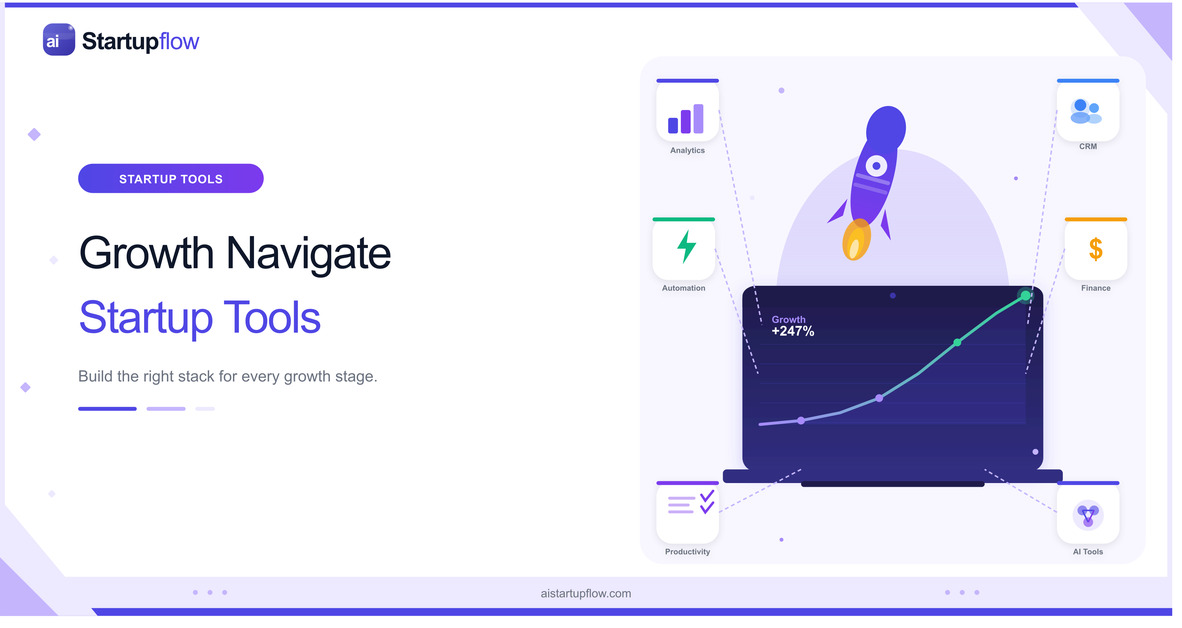
A well-built growth tool stack covers five functions: tracking what is happening (analytics), reaching and converting customers (marketing and CRM), organizing your team’s work (productivity), eliminating repetitive tasks (automation), and managing your money (financial tracking).
Why Most Founders Build Their Stack Wrong
The most common mistake is building a full tool stack before you have validated anything.
A pre-revenue founder does not need Salesforce. A five-person team does not need enterprise project management software. When you adopt tools ahead of your actual complexity, you create three problems: you pay for features you do not use, your team loses time learning software that does not matter yet, and you end up with overlapping tools that do the same job.
Marketing automation alone reduces manual work by 61% — but only when the right tool is in place at the right stage. The same tool adopted too early becomes a distraction.
The solution is building your stack by stage adding tools only when your current complexity actually demands them.
The 5 Categories Every Startup Stack Needs
Before choosing specific tools, understand the five functions your stack must cover. Every tool you add should map clearly to one of these categories.
1. Analytics Tools
Analytics tools tell you what is actually happening in your business, who visits your site, where they drop off, which features drive retention, and which channels bring your best customers.
Without analytics, every growth decision is a guess. With it, you can see exactly where to focus.
Best options: Google Analytics 4 is free and covers most early-stage needs. Hotjar adds heatmaps and session recordings that show how users actually interact with your product. Mixpanel is the right upgrade when you need event-based product analytics.
2. Marketing and CRM Tools
Marketing tools bring customers in. CRM tools track and manage them once they show interest. Together they form the customer acquisition engine of your startup.
87% of startups now use a CRM system; it is the most widely adopted startup tool category in 2026. The reason is simple: without a CRM, leads fall through the cracks, follow-ups get missed, and revenue opportunities disappear.
Best options: HubSpot CRM is the best free starting point — it handles contact management, email sequences, and deal tracking in one place. Mailchimp handles email marketing for early-stage teams. When you are ready to scale outbound, Apollo.io adds prospecting and automated sequences.
3. Productivity and Planning Tools
Productivity tools keep your team organized, aligned, and moving fast. At the early stage, this means a single workspace where strategy, tasks, documentation, and communication all live together.
Best options: Notion is the most flexible option for early-stage teams; it handles project planning, documentation, and team wikis in one place. Trello works for simple kanban-style task management. Linear is the best choice for product and engineering teams that need structured sprint planning.
4. Automation Tools
Automation tools connect your other tools together and eliminate the repetitive tasks that eat founder time. When a new lead fills out a form, automation adds them to your CRM, sends a Slack notification, and triggers a welcome email — without you touching anything.
Every hour saved through automation is an hour redirected toward growth. For a full breakdown of which AI-powered automation tools work best for startups, our guide on AI tools for startups covers the top options in detail.
Best options: Zapier connects 6,000+ apps with no code required. Make (formerly Integromat) offers more flexibility at a lower price point. n8n is the best choice for technical founders who want full control with self-hosting.
5. Financial Tracking Tools
Financial tools track your cash flow, manage invoices, and keep your numbers investor-ready. For a bootstrapped startup, financial visibility is survival; you cannot manage what you cannot measure.
Best options: Mercury is the best startup bank account built specifically for startups with no fees and clean integrations. FreshBooks handles invoicing and basic accounting for service businesses. For more complex financial modeling and projections, our guide on building a financial model for your startup walks through the full process.
Build Your Stack by Stage — Not All at Once
The biggest mistake founders make is trying to build a complete stack on day one. Your tool needs change dramatically as your business grows. Here is how to think about it by stage.
Stage 1. Pre-Revenue (0 to $1k MRR)
At this stage, your only job is to validate that customers will pay for your product. Your tool stack should be minimal — anything that does not directly help you get paying customers is a distraction.
Essential tools only:
- Google Analytics 4 — free, set it up immediately
- Notion — free tier covers all planning and documentation needs
- HubSpot CRM — free tier handles your first 100 contacts easily
- Gmail or similar — no email marketing tool needed yet
Monthly cost: $0
Stage 2. Early Revenue ($1k to $10k MRR)
You now have paying customers and repeatable revenue. Your focus shifts to understanding what is working and doing more of it. This is when automation and marketing tools start paying for themselves.
Add to your stack:
- Mailchimp or ConvertKit ($13–$25/month) — email marketing to nurture and retain customers
- Zapier Starter ($20/month) — automate lead routing and onboarding workflows
- Hotjar ($39/month) — understand exactly how users interact with your product
- FreshBooks ($17/month) — clean invoicing and basic financial tracking
Monthly cost: $89–$101
Stage 3. Scaling ($10k+ MRR)
At this stage, you are no longer just validating — you are building repeatable systems for customer acquisition, retention, and operations. Your tools need to scale with your team.
Upgrade and add:
- HubSpot Sales Hub ($45/month) — upgrade from free CRM as pipeline complexity grows
- Mixpanel ($28/month) — product analytics for understanding feature adoption and churn
- Apollo.io ($49/month) — outbound prospecting and automated sequences
- Linear ($8/user/month) — structured product and engineering planning
- Slack ($7.25/user/month) — team communication as headcount grows
Monthly cost: $150–$250+ depending on team size
The Real Cost of a Startup Tool Stack in 2026
| Stage | Tools | Monthly Cost |
|---|---|---|
| Pre-Revenue | GA4, Notion, HubSpot Free | $0 |
| Early Revenue | Add Mailchimp, Zapier, Hotjar, FreshBooks | $89–$101 |
| Scaling | Full stack with paid upgrades | $150–$250+ |
The key insight: a pre-revenue founder can run a fully functional growth stack for free. An early-revenue founder can have everything they need for under $100/month. Scaling only requires significant tool spend once revenue supports it.
Tool costs should never exceed 5 to 8 percent of your monthly revenue. If your tool spend is higher than that, you have either over-built your stack or you are using tools at the wrong stage.
Free vs Paid — When to Upgrade
Most growth navigate startup tools offer free tiers. The question is not whether to use free tools — it is knowing exactly when to upgrade.
Upgrade from free to paid when any of the following is true:
You are consistently hitting plan limits. If you are at 90 percent of your free tier limits every month, upgrade before you hit the ceiling and lose data or functionality.
The missing feature is blocking growth. If a paid feature would directly unlock a revenue opportunity — like automated email sequences or advanced segmentation — the upgrade cost is almost always worth it.
Your team is losing time working around the tool’s limitations. If your team is manually doing something the paid plan would automate, calculate the hourly cost of that manual work and compare it to the upgrade price.
Do not upgrade because a tool looks impressive, because a competitor uses it, or because a sales rep tells you to. Upgrade only when the business need is clear and measurable.
How to Run a Quarterly Stack Audit
Most founders never audit their tool stack. They add tools, forget about them, and keep paying. A quarterly audit fixes this.
Every three months, run through this process:
Step 1: List every tool and its monthly cost. Include everything: subscriptions, annual plans divided by 12, any per-seat charges.
Step 2: Check actual usage for each tool. Most SaaS tools show login frequency and feature usage in their admin dashboard. If less than 80 percent of your team actively uses a tool, it is a candidate for removal.
Step 3: Check for overlap. Are two tools doing the same job? Common overlaps: Notion plus Asana (both handle task management), Zapier plus Make (both handle automation), HubSpot plus Mailchimp (both handle email). Pick one and cancel the other.
Step 4: Calculate your total stack cost as a percentage of MRR. If it exceeds 8 percent, cut something.
Step 5: Identify one tool that is blocking growth. Every stack has a weak link — a tool that is too limited for where the business is now. Identify it and either upgrade or replace it.
This review takes 45 minutes. Done every quarter, it keeps your stack lean, effective, and aligned with where your business actually is.
Frequently Asked Questions
What are growth navigate startup tools?
They are software platforms chosen specifically to help early-stage startups grow faster, track performance, and automate operations built as a deliberate system, not a random collection of apps.
How many tools does a startup actually need?
Most early-stage startups need 4 to 6 core tools. Cap your active stack at 6 to 8 tools maximum beyond that, complexity costs more than the tools save.
What is the best free startup tool stack?
Google Analytics 4, HubSpot CRM free tier, Notion free tier, and Zapier free tier cover most pre-revenue needs at zero cost.
When should a startup start paying for tools?
Once you hit consistent revenue — typically $1,000 to $3,000 MRR — and when free tier limits are consistently blocking your workflow.
How do I know if a tool is worth keeping?
If less than 80 percent of your team uses it actively, or if you cannot directly connect it to a business outcome (leads, retention, time saved), cut it.
Conclusion
The right growth navigate startup tools do not build your company for you. But they give a small team the leverage to move like a much larger one — acquiring customers faster, retaining them longer, and operating without the overhead that kills early-stage momentum.
Start with the minimum viable stack. Add tools only when your current stage demands them. Audit every quarter. And always connect every tool in your stack to a real business outcome.
Building your financial foundation alongside your growth tools? Read our complete guide: Financial Model for Startup: A Simple Step-by-Step Guide