
Table of Contents
Paid ads give you traffic the moment you pay and silence the moment you stop. Content marketing gives you traffic that compounds month after month without paying for every click.
For a bootstrapped startup with a limited budget and a small team, that difference is everything.
But content marketing for startups is not about publishing blog posts and hoping something ranks. It is a deliberate system choosing the right topics, publishing consistently, repurposing strategically, and showing up in the places where your customers are searching. Including, in 2026, the AI search platforms that are reshaping how buyers discover solutions.
This guide gives you that system from scratch.
Why Content Marketing Works Better Than Paid Ads for Startups
Most early-stage founders default to paid ads because the feedback loop is immediate. Run an ad, see clicks. Stop the ad, see nothing.
Content marketing feels slower but the economics are dramatically different. According to HubSpot’s 2026 State of Marketing Report, content marketing generates three times more leads than paid search while costing 62 percent less. For a startup watching every dollar, that is not a marginal improvement — it is a structural advantage.
Three reasons content marketing outperforms paid ads for startups specifically:
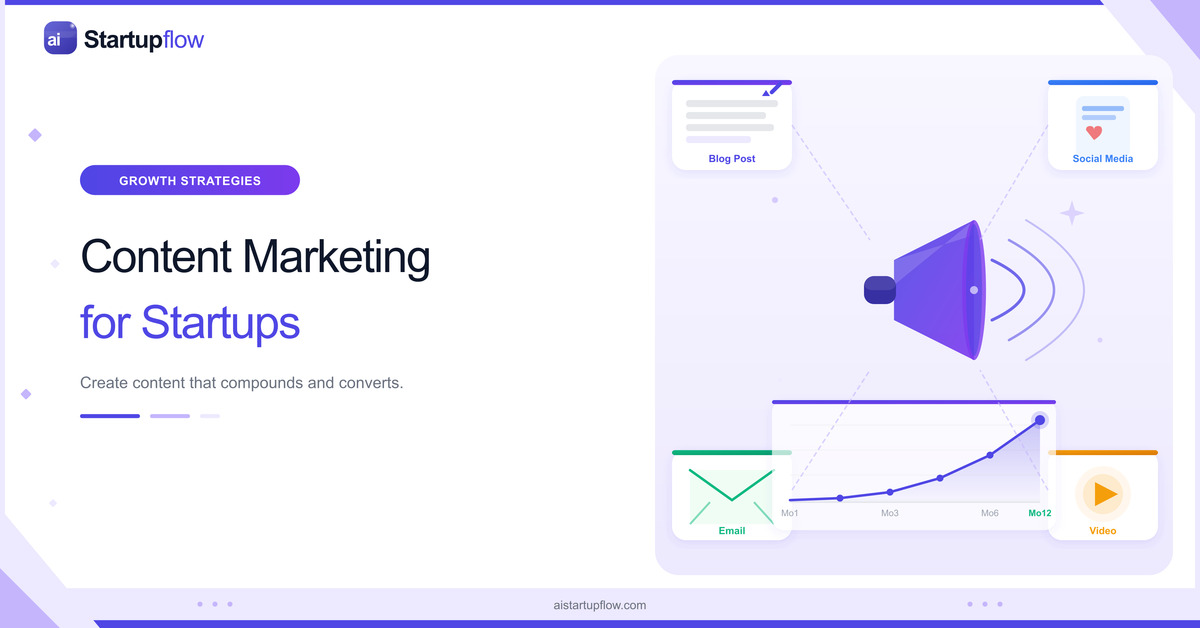
It compounds over time. A blog post published today can drive traffic in six months, eighteen months, and three years from now. An ad campaign stops the moment the budget runs out. The cumulative value of a content library grows without proportional additional cost.
It attracts high-intent buyers. Someone searching “how to build a startup financial model” is actively looking for a solution. Someone who sees your paid ad on social media was not looking for anything. Intent-based traffic converts at significantly higher rates than interruption-based traffic.
It builds authority that paid ads cannot. When your content consistently answers your audience’s questions, they begin to trust your brand before they ever talk to you. That trust is a sales asset that no ad budget can replicate.
The Right Content Types for Each Stage of the Buyer Journey
Not all content serves the same purpose. The biggest mistake startup founders make is publishing only one type of content, usually broad awareness posts and wondering why it does not drive revenue.
Every piece of content you create should map to a specific stage of your buyer’s journey.
Awareness Stage Blog Posts, Guides, How-To Content
Awareness content targets people who have a problem but have not yet identified your solution as the answer. They are searching for information, not products.
Blog posts, step-by-step guides, and how-to articles are the most effective formats at this stage. Target informational keywords with low difficulty the kind of queries your ideal customer types when they are early in their research. A founder searching “how to get website traffic” or “what is a financial model” is at the awareness stage.
Your goal with awareness content is to be the most helpful source they find. Do not pitch your product. Solve the problem completely. Trust comes before conversion.
Consideration Stage Case Studies, Comparisons, Tool Reviews
Consideration content targets buyers who know what they need but are evaluating options. They are comparing solutions, reading reviews, and looking for evidence that your approach works.
Case studies, comparison posts (“X vs Y”), and tool review articles perform best here. These formats directly address the questions a buyer asks before making a decision: “What are the best AI tools for startups?” or “What is the difference between building custom and using no-code?”
This is where your content starts to generate commercial value. For example, our guide on growth navigate startup tools targets founders who are actively evaluating which tools belong in their stack exactly the consideration stage mindset.
Decision Stage Testimonials, ROI Examples, Specific Comparisons
Decision content targets buyers who are close to choosing. They need social proof, specific outcomes, and confidence that choosing you is the right decision.
Customer success stories, ROI breakdowns, and “best for X type of startup” posts work best here. Keep these tightly focused on outcomes, real numbers, specific results, concrete before-and-after scenarios.
How to Build a Content Strategy From Zero
A content strategy is not a content calendar. It is a set of decisions about what you will write, for whom, and why made before you write a single word.
Pick One Core Topic and Own It
The fastest path to content authority is depth, not breadth. Choose one narrow topic that sits at the intersection of your audience’s biggest problem and your product’s core value, and cover it more comprehensively than anyone else.
A startup in the financial modeling space should own financial modeling for founders, not “startup growth” or “business strategy.” A startup in the AI tools space should own AI tools for startups not “AI” broadly.
Topical authority signals to Google and to AI systems that your site is the most credible source on a specific subject. Broad, shallow coverage across many topics produces the opposite signal.
Bottom-Up Keyword Research for Startups
New startup websites have low domain authority. Competing for high-volume, high-difficulty keywords against established sites is a losing strategy.
Instead, target long-tail keywords three to five word phrases with 500 to 3,000 monthly searches and keyword difficulty below 30. These terms get less traffic individually, but they rank faster, attract more specific buyers, and build the topical authority that makes future content rank more easily.
Process: use SEMrush or Ahrefs to find keywords in your niche with KD under 30. Filter by informational or commercial intent. Look for clusters of related keywords topics you can cover in five to ten interconnected posts rather than isolated single keywords.
Map Every Piece of Content to a Business Goal
Every piece of content should serve one of three purposes: bring new visitors to the site (traffic), convert existing visitors into leads or subscribers (conversion), or build authority that makes future content rank faster (authority).
Before publishing anything, write down which goal it serves and how you will measure success. Traffic posts are measured by organic sessions. Conversion posts are measured by email signups, demo requests, or sales. Authority posts are measured by backlinks and ranking improvement of related pages.
Content without a goal is noise.
The Solo Founder Content System
Most content marketing advice assumes you have a team. You probably do not. Here is a system designed for one person.
Weekly Content Rhythm What to Publish and When
The goal is consistency over volume. One high-quality, well-optimized piece of content per week outperforms five thin posts every time.
A realistic weekly rhythm for a solo founder:
Monday: Keyword research and topic selection for this week’s content. Identify the primary keyword, check search intent, and review what already ranks.
Tuesday to Wednesday: Write the full post. Use AI tools to draft, then rewrite heavily in your own voice. AI drafts are starting points, not finished content.
Thursday: Optimize and format. Add internal links, check keyword placement, write the meta title and description, add image alt text.
Friday: Publish and distribute. Share to your email list, LinkedIn, and any relevant communities where your audience is active.
This rhythm produces 48 to 52 pieces of content per year a content library that compounds in value every month.
One Piece, Five Formats The Repurposing Framework
The biggest leverage in content marketing is repurposing. One well-researched blog post contains enough material for five different content assets across five different channels.
From a single blog post, extract:
LinkedIn post Take the most counterintuitive insight from the post and write a 200-word take that challenges conventional wisdom. Link to the full post.
Email newsletter Summarize the three most actionable points from the post and send to your subscriber list. This drives traffic back to the full post and keeps your audience engaged between publishing cycles.
Twitter/X thread Pull the step-by-step process from the post and turn it into a numbered thread. Each step is one tweet. Final tweet links to the full guide.
Short video script Turn the introduction and key framework into a 60-second video script. Post on LinkedIn or YouTube Shorts.
FAQ post Extract the five questions you answered in the post and create a standalone FAQ page targeting “people also ask” queries in Google.
One research session. Five content assets. Five distribution channels. This is how solo founders produce content volume that looks like a team effort.
AI Content Workflow for Startups in 2026
AI has changed what a solo founder can produce but not in the way most people think. AI does not replace your expertise. It compresses the time between research and first draft, freeing you to spend your limited time on the parts that actually require human judgment.
Research to Publish in Half the Time
A realistic AI-assisted content workflow:
Step 1. Research: Use Claude or ChatGPT to summarize top-ranking content on your target keyword. Ask: “What are the main angles covered by existing content on [topic]? What questions do they fail to answer?” This gives you your content gap in minutes instead of hours.
Step 2. Outline: Ask your AI assistant to generate a detailed outline based on your target keyword and the gaps you identified. Edit aggressively add sections unique to your perspective, remove generic sections that every competitor covers.
Step 3. Draft: Use AI to write a first draft section by section. Be specific in your prompts: “Write a 250-word section on [specific subtopic] targeting [primary keyword], written for early-stage startup founders, in a direct and practical tone.”
Step 4. Rewrite: This is the step most founders skip — and it is the most important. Rewrite every AI-generated paragraph in your own voice. Add specific examples, real numbers, and opinions that only you can provide. This is what separates content that ranks from content that blends in.
Step 5. Optimize: Run the final draft through Rank Math or Surfer SEO. Adjust keyword placement, add internal links, and write the meta data.
What AI Handles vs What Only You Can Write
AI handles: structure, first drafts, summarizing research, generating FAQ questions, writing meta descriptions, and creating social media variations.
Only you can provide: firsthand experience, specific case studies from your own startup, contrarian opinions, real customer insights, and the authentic voice that builds audience trust over time. These are the elements that make content worth reading — and worth citing by AI systems.
GEO How to Get Cited in AI Search Results
Generative Engine Optimization (GEO) is the practice of structuring your content so that AI systems ChatGPT, Perplexity, Claude, Google AI Overviews cite your content when answering questions in your niche.
This is the biggest content marketing opportunity most startups are completely missing in 2026.
Three practices that increase AI citation frequency:
Write with clear, citable answers. AI systems extract specific, direct answers to specific questions. Structure your content with H2 and H3 headings that match common queries, and open each section with a direct two-sentence answer before expanding. The more extractable your content, the more likely AI systems are to cite it.
Build topical authority through depth. AI systems prefer sources that cover a topic comprehensively. Ten deep posts on startup financial modeling signal more authority than one post on fifty unrelated topics. The same topical depth that helps Google rankings helps AI citation frequency.
Track your AI visibility monthly. Query ChatGPT and Perplexity with your top ten target keywords every month. Note whether your brand or content appears. Growing branded search volume in Google Search Console is a proxy signal that AI systems are mentioning your brand and sending referral traffic your way.
How to Measure Content Marketing ROI
Content marketing ROI is real but it takes longer to materialize than paid ads, and it requires tracking the right metrics.
Organic traffic growth Track monthly sessions from organic search in Google Analytics. Expect slow growth in months one to three, accelerating growth from months three to six, and compounding growth from month six onward.
Keyword rankings Track your target keywords weekly in Google Search Console. Moving from position 15 to position 5 for a 1,000-search-per-month keyword is worth roughly 80 to 120 additional monthly visitors without publishing anything new.
Lead attribution Track which blog posts generate the most email signups, demo requests, or product trials. These are your highest-value pages prioritize updating and promoting them.
Content ROI formula: (Revenue attributed to organic traffic) divided by (Total content production cost) x 100. Most startups find content becomes their most cost-effective acquisition channel within six to twelve months but only if they track it consistently from the start.
Frequently Asked Questions
What is content marketing for startups?
Content marketing for startups is the practice of creating and publishing valuable content blog posts, guides, case studies to attract organic traffic, build authority, and convert readers into customers without relying on paid advertising.
How long does content marketing take to show results?
Most startups see early organic traffic in months three to six, with compounding results after month twelve. The timeline depends on keyword difficulty, publishing consistency, and content quality. Low-KD keywords can rank in four to eight weeks.
How much content should a startup publish per week?
One high-quality, well-optimized post per week is the right starting point for most solo founders. Consistency matters more than volume one post per week for twelve months outperforms five posts per week for two months then nothing.
Can a solo founder do content marketing without a team?
Yes. With AI tools for research and drafting, a clear weekly rhythm, and a content repurposing framework, one founder can produce and distribute content across multiple channels in eight to ten hours per week.
What is GEO and why does it matter for startup content marketing?
GEO stands for Generative Engine Optimization structuring content so AI systems like ChatGPT and Perplexity cite it in their answers. As AI search grows, appearing in AI-generated responses becomes as important as appearing on page one of Google.
Conclusion
Content marketing for startups is not a shortcut but it is the highest-leverage growth channel available to a founder with limited budget and unlimited ambition.
Build your content strategy around one core topic. Publish consistently. Use AI tools to move faster without sacrificing quality. Repurpose everything. And in 2026, optimize for AI citations alongside traditional search rankings.
The founders who build this system today will have a compounding traffic asset twelve months from now that their competitors cannot buy their way into.
Ready to build the SEO foundation your content strategy needs?
Read our complete guide: SEO for Startups: The Complete 2026 Founder’s Guide