
Table of Contents
Paid ads stop the moment you stop paying. SEO compounds.
A blog post you publish today can drive traffic in six months, twelve months, and three years from now without touching your ad budget. For a startup with limited capital and unlimited ambition, that math is hard to argue with.
But most founders approach SEO for startups the wrong way. They either ignore it entirely, convinced it takes too long or they try to do everything at once and get buried in complexity before seeing a single result.
This guide cuts through both problems. It gives you the exact framework, step by step, that a founder with no SEO background can use to start ranking, start attracting organic traffic, and build a search presence that grows alongside the business.
Why SEO Is the Highest-ROI Growth Channel for Startups
Every growth channel has a cost. Paid social costs money per click. Influencer campaigns cost money per post. Cold outreach costs time per reply.
SEO costs time upfront and then it pays you back indefinitely.
According to HubSpot’s 2026 State of Marketing Report, 68% of online experiences begin with a search engine and AI-powered search is now one of the fastest-growing discovery channels for B2B buyers. The search landscape is expanding, not shrinking. And the startups building content now are the ones who will own that expanded surface area when it fully matures.
For early-stage founders specifically, SEO offers three advantages no other channel can match. First, the traffic is intent-based. People searching for your topic are already looking for a solution, which means conversion rates are higher than interruption-based channels. Second, it builds compounding authority every piece of content you publish adds to your site’s credibility, making future content rank faster. Third, it is scalable without proportional cost publishing your tenth blog post costs the same as publishing your first, but it benefits from everything the first nine built.
The founders who commit to SEO early are the ones who find themselves with a defensible traffic moat twelve to eighteen months later that competitors cannot buy their way into overnight.
The Founder’s 80/20 SEO Framework
Most SEO advice is written for agencies managing dozens of clients with dedicated teams. You are one person with a company to build.
The 80/20 rule applies more aggressively to SEO than almost any other discipline. Roughly 20 percent of SEO actions produce roughly 80 percent of the results. For a founder, this means ruthless prioritization.
The 20 percent that actually moves the needle:
- Targeting low-competition, high-intent keywords instead of head terms
- Publishing well-structured, genuinely useful long-form content consistently
- Getting your technical basics right once and maintaining them
- Building a small number of high-quality backlinks from relevant sources
- Optimizing your highest-traffic pages for conversions
The 80 percent that feels productive but barely moves the needle:
- Obsessing over exact keyword density
- Chasing backlinks from irrelevant sites
- Rewriting content that is already ranking
- Publishing thin content at high volume
- Tracking rankings daily instead of monthly
Commit to the 20 percent. Do it consistently. The results will come.
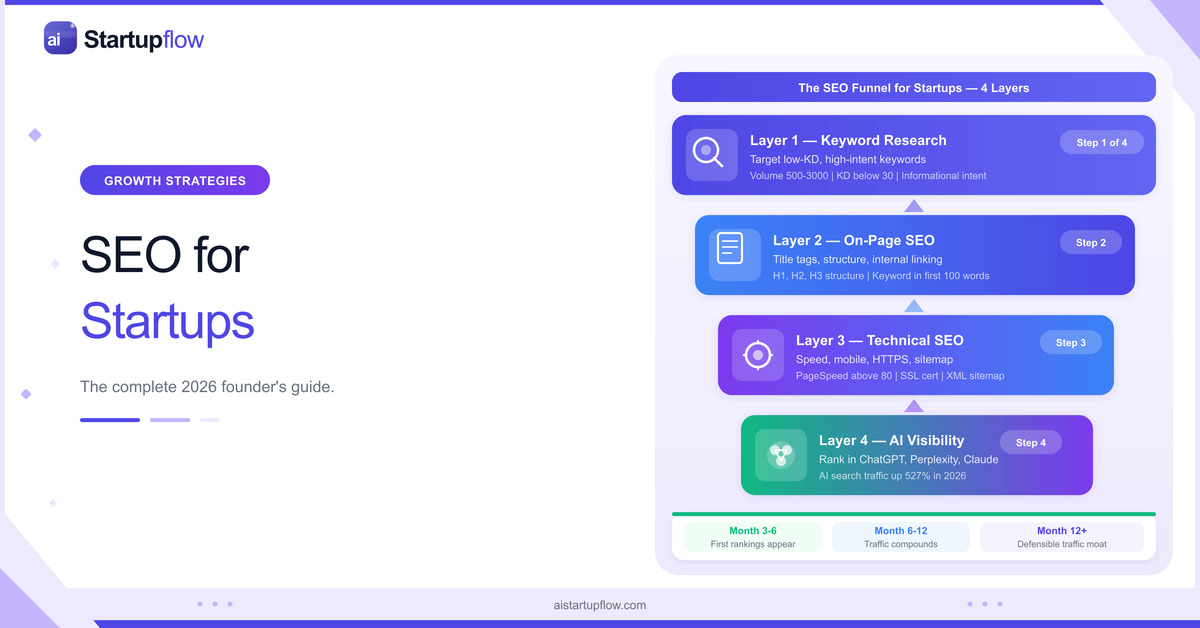
Step 1: Keyword Research Without an Agency
Keyword research is where most founders get stuck either because they target keywords that are too competitive or because they pick keywords with no real search volume. Both mistakes produce the same result: content that nobody reads.
Bottom-Up Keyword Strategy
Start with specificity, not breadth. A new startup website has essentially zero domain authority. Trying to rank for broad terms like “startup tools” or “financial modeling” against established sites with thousands of backlinks is a losing game from day one.
Instead, target long-tail keywords three to five word phrases with 500 to 3,000 monthly searches and a keyword difficulty below 30. These are the searches your ideal customer makes when they are close to a decision, not when they are broadly exploring a topic.
Practical process: open Google Search Console, type your core topic into Google, and look at the “People Also Ask” and “Related Searches” sections. These are real queries your audience is typing and they are often far less competitive than the main keyword.
Verify your keyword data in SEMrush or Ahrefs before committing to a topic. Look for: monthly search volume above 500, keyword difficulty below 30, and informational or commercial intent.
Search Intent The One Thing Most Founders Miss
Search intent is the reason behind a query. Google’s entire algorithm is built around matching content to intent and if your content does not match the intent of the keyword you are targeting, it will not rank regardless of how well optimized it is.
Four types of intent: informational (the searcher wants to learn), commercial (the searcher is comparing options), transactional (the searcher is ready to purchase), and navigational (the searcher wants a specific site).
For a startup blog, target informational and commercial intent. Before writing any piece of content, Google the keyword yourself and look at the top five results. What format are they in? What angle do they take? Your content needs to match that intent — and then go deeper.
Step 2: On-Page SEO That Actually Ranks
On-page SEO is everything you control inside the content itself. Get these fundamentals right and you give every piece of content the best possible chance to rank.
Title Tags and Meta Descriptions
Your title tag is the single most important on-page SEO element. Rules for effective title tags: include your primary keyword ideally at the beginning, keep it under 60 characters, and make it compelling enough to earn the click.
Your meta description does not directly affect rankings but directly affects click-through rate. Write it like a one-sentence pitch: what does this page contain, and why should the reader click?
Content Structure and Internal Linking
Use H1 for your page title, H2 for major sections, and H3 for subsections. Internal linking is one of the most underused SEO tactics for new sites. Every piece of content you publish should link to two or three other relevant pages on your site using descriptive anchor text.
This helps Google understand the relationship between your content and passes authority from higher-ranking pages to newer ones. For example, a blog post about SEO strategy can naturally link to a guide on how to get website traffic connecting related topics in a way that serves both the reader and the search engine.
Keyword Placement Rules
Your primary keyword should appear in: the H1 title, the first 100 words, at least one H2 heading, the meta description, the URL slug, and at least one image alt text. Beyond that, use keyword variations naturally throughout the content without mechanical repetition.
Step 3: Technical SEO for Non-Technical Founders
Technical SEO sounds intimidating but the foundational elements are simpler than most guides suggest. Run through this checklist once and you cover 90 percent of what matters.
Page speed. Use Google PageSpeed Insights to test your pages. Aim for a score above 80 on mobile. Compress images before uploading, use a caching plugin on WordPress, and choose a fast hosting provider.
Mobile responsiveness. More than 60 percent of searches happen on mobile. Your site must render correctly on all screen sizes. Use Google’s Mobile-Friendly Test tool to verify.
HTTPS. Your site must have an SSL certificate. Every modern hosting provider offers this for free. Google treats non-HTTPS sites as insecure and deprioritizes them in rankings.
XML sitemap. A sitemap tells Google which pages exist on your site. Rank Math generates one automatically for WordPress sites. Submit it to Google Search Console so Google can index your content faster.
Broken links. Use Screaming Frog (free up to 500 URLs) to crawl your site and identify broken links. Fix or redirect any you find broken links, waste crawl budget and hurt user experience.
Step 4: AI Search Visibility in 2026
In 2026, ranking on Google is no longer enough. Your potential customers are increasingly finding answers through ChatGPT, Perplexity, Claude, and other AI platforms — and the startups that appear in those AI-generated answers have a significant traffic advantage over those that do not.
According to research cited by Averi.ai, ChatGPT primarily cites lower-ranking pages about 90 percent of the time meaning AI citations do not require high domain authority. A well-written, well-structured blog post on a startup with low domain rating can get cited by AI systems before it ever reaches page one of Google.
How to optimize for AI search visibility:
Write with clear, citable answers. AI systems look for content that directly answers specific questions. Structure your content with clear H2 and H3 headings that match common queries, and include direct answers in the first two to three sentences under each heading.
Build topical authority. AI systems prefer sources that cover a topic comprehensively. Publishing five well-researched posts on startup financial modeling signals more authority than one post on fifty unrelated topics. Depth beats breadth.
Get cited by authoritative sources. When established sites link to your content, AI training data and real-time retrieval systems treat your content as more credible. One quality backlink from a relevant authoritative source is worth more than fifty low-quality links.
Track your AI visibility. Query ChatGPT and Perplexity monthly with your top ten target keywords. Document whether your brand or content appears. Growing branded search volume in Google Search Console is a proxy signal that AI systems are mentioning your brand.
Realistic SEO Timeline What to Expect
The single biggest reason founders give up on SEO is unrealistic expectations. Here is what the honest timeline looks like.
Months 1 to 3 Foundation and indexing. You are publishing content, getting indexed, and starting to appear for very long-tail, low-competition queries. Traffic is minimal. This is normal. The work you do now is building the foundation for everything that follows.
Months 3 to 6 Early signals. Google starts to understand your site’s topical focus. Impressions grow faster than clicks. A few pages begin climbing toward page one for lower-competition keywords. You may see your first meaningful organic visitors from SEO during this period.
Months 6 to 12 Compounding begins. Pages that ranked position 8 to 15 start moving to positions 3 to 7. Traffic increases noticeably. Internal links begin passing authority to newer content, making it rank faster than your earlier posts did.
Month 12 and beyond Defensible moat. Consistent publishing and link building produce an organic traffic base that grows month over month without proportional additional effort. This is the compounding effect that makes SEO the highest-ROI long-term channel for startups.
The founders who see this timeline and commit to it are the ones who look back eighteen months later with a traffic asset their competitors cannot replicate overnight.
Best Free SEO Tools for Startups
You do not need to spend money to build a solid SEO foundation. These free tools cover everything a pre-revenue or early-revenue startup needs.
Google Search Console. The most important SEO tool available. Shows you which queries bring visitors to your site, which pages rank, average position, and click-through rate. Free, essential, and directly from Google. Set it up on day one.
Google Analytics 4. Tracks user behavior on your site: which pages visitors read, how long they stay, and where they come from. Connect it with Search Console for a complete picture of your organic traffic.
Google PageSpeed Insights. Tests your page speed and gives specific recommendations for improvement. Free and accurate.
Rank Math (WordPress). The best free SEO plugin for WordPress. Handles meta tags, XML sitemaps, schema markup, and gives you a real-time content score as you write. Integrates directly with Google Search Console.
Screaming Frog. Crawls your site and identifies technical issues: broken links, missing meta tags, duplicate content, and redirect chains. Free up to 500 URLs.
For a complete breakdown of paid AI-powered SEO tools worth upgrading to when your budget allows, our guide on AI tools for startups covers Surfer SEO and other tools that serious startup content teams use in 2026.
FAQs: SEO for Startups
How long does SEO take for a startup?
Most startups see meaningful organic traffic between months 3 and 6, with compounding results after month 12. The timeline depends on consistency of publishing, keyword difficulty, and the quality of content.
Can a startup do SEO without an agency?
Yes. A founder with the right framework and free tools can build a strong SEO foundation without any agency. Start with Google Search Console, target low-competition keywords, and publish consistently useful content.
How many blog posts does a startup need to rank?
Quality matters more than quantity. Ten well-researched, properly optimized posts on closely related topics will outperform fifty thin, unrelated posts. Focus on building topical authority in your niche before expanding.
What is the most important SEO factor for a new startup site?
Keyword targeting. A new site cannot compete for high-competition keywords regardless of content quality. Targeting long-tail keywords with low difficulty is the single most important decision a startup founder makes in their SEO strategy.
Does social media help with SEO?
Social media does not directly affect Google rankings. However, it helps content get discovered and linked to and backlinks from relevant sites are one of the strongest ranking signals. Use social media to distribute content, not to replace SEO.
Conclusion
SEO for startups is not about gaming an algorithm. It is about building a content asset that compounds in value over time attracting the exact customers who are already searching for what you offer.
Start with keyword research. Get your technical basics right. Publish consistently useful content. Build internal links between your pages. And in 2026, make sure you are also visible in the AI search platforms where your customers are increasingly looking first.
The founders who start this process today will have a traffic moat that cannot be bought or copied twelve months from now.
Ready to build the growth stack your SEO strategy feeds into?
Read our complete guide: Growth Navigate Startup Tools: Best Stack for Founders in 2026