
Table of Contents
A financial model for your startup is not just a spreadsheet it is the story of your business told through numbers. It shows investors how you plan to make money, how much it will cost to run your business, when you expect to become profitable, and how much funding you actually need. Without it, even the most brilliant startup idea can fail to attract serious investors or secure funding.
The word “financial model” can sound intimidating, especially if you do not have a background in finance or accounting. But the truth is, a startup financial model does not need to be complicated. What it needs to be is clear, logical, and grounded in realistic assumptions.
In this step-by-step guide, we will show you exactly how to build a simple but powerful financial model for your startup one that will help you make smarter decisions and impress even the most experienced investors.
What Exactly is a Financial Model for Startup?
A financial model is a structured spreadsheet that forecasts your startup’s financial performance over a defined period usually 12 months for early-stage startups and 3 to 5 years for those seeking significant investment. It brings together your revenue projections, cost structure, and cash flow into a single, coherent picture.
Think of it as a flight simulator for your business. Before a pilot takes a plane into the air, they run simulations to understand how the aircraft will behave under different conditions. A financial model does the same thing for your startup it lets you test different scenarios, identify risks early, and make data-driven decisions before committing real money.
A well-built financial model covers three core areas:
- Revenue: How much money your startup will earn and from which sources
- Expenses: How much it costs to build, operate, and grow the business
- Profit and Loss: Whether the business is making or losing money over time
Set Up Your Spreadsheet Structure
Start with Google Sheets or Microsoft Excel both are free or low-cost and widely accepted by investors. Open a new file and create the following tabs at the bottom of your spreadsheet. Each tab will hold a different part of your financial model.
- Assumptions: The key inputs that drive all your other numbers (growth rate, pricing, team size)
- Revenue: All your income sources and how they grow month by month
- Expenses: All your costs broken down by category
- P&L Summary: Your profit and loss statement showing the bottom line
- Cash Flow: Your actual cash position month by month
In the top row of each tab, set up your time axis columns for each month across 12 months. If you are building a 3-year model, extend this to 36 months. This structure will make your model easy to read and navigate.
Define Your Revenue Streams
Your revenue tab is where you forecast how much money your startup will make. The key here is to build your revenue model from the bottom up starting with the number of customers you expect to acquire and the price they will pay, rather than just picking a big number and working backwards.
This approach is more credible to investors because every number has a logical basis. If you project $100,000 in monthly revenue, you should be able to explain exactly how many customers at what price point get you there.
Common Startup Revenue Models:
- Subscription Model: Customers pay a recurring monthly or annual fee (common for SaaS products). Formula: Number of Subscribers x Monthly Price
- One-Time Sales: Customers pay once per product or service purchased. Formula: Units Sold x Price Per Unit
- Service-Based: Revenue is earned per client, project, or hour. Formula: Number of Clients x Average Project Value
- Advertising: Revenue based on website traffic or app usage. Formula: Monthly Visitors x CPM Rate
Important: Be conservative in your projections. It is far better to under-promise and over-deliver than to present wildly optimistic numbers that no one believes.
List Every Expense in Detail
Underestimating costs is one of the most common and dangerous mistakes startup founders make when building their financial model. Be thorough and honest about every expense even the small ones add up quickly and can seriously affect your cash flow if you do not account for them.
Break your expenses into two categories: fixed costs (costs that stay the same every month regardless of your revenue) and variable costs (costs that grow as your business grows). This distinction is important because it helps you understand your break-even point and your unit economics.
Common Startup Expenses to Include:
- Salaries and contractor fees include your own salary if you plan to pay yourself
- Software subscriptions and SaaS tools hosting, CRM, email marketing, design tools
- Marketing and advertising costs Google Ads, social media ads, content creation
- Domain, hosting, and website maintenance fees
- Legal and accounting fees company formation, contracts, tax filing
- Customer acquisition cost how much it costs to acquire each new customer
- Office, co-working space, or equipment costs if applicable
Build Your Profit and Loss Statement
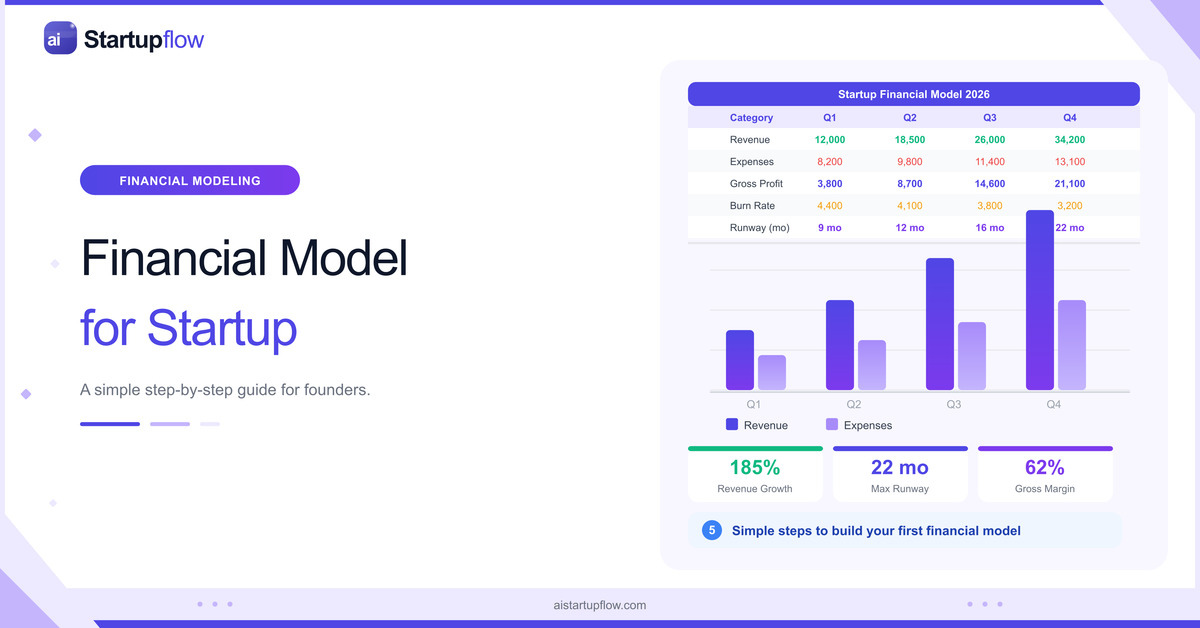
Your Profit and Loss (P&L) statement is the heart of your financial model. It brings together your revenue and expenses to show whether your startup is making money or losing money in any given month. Most early-stage startups will show losses in the first several months and that is completely normal and expected.
What investors want to see is not that you are profitable from day one, but that your path to profitability is logical, realistic, and clearly defined. Your P&L should tell a story: this is where we start, this is how we grow, and this is when we break even.
Key Formula: Gross Profit = Revenue – Cost of Goods Sold. Net Profit/Loss = Gross Profit – Operating Expenses.
Review your P&L every single month. If your actual numbers are significantly different from your projections, update your model and understand why. A financial model is a living document — it should evolve as your business does.
Monitor Your Cash Flow Closely
Many startups that appear profitable on paper still run out of cash and fail. This happens because of the difference between profit and cash flow. Profit is an accounting concept — it measures revenue minus expenses on paper. Cash flow is reality it measures the actual money flowing in and out of your bank account.
For example, you might close a $10,000 deal in January, but if the client does not pay until March, you have a cash flow gap of two months. During those two months, you still need to pay salaries, software subscriptions, and other expenses. If you do not have enough cash in the bank to cover those costs, your startup is in serious trouble even though on paper you are profitable.
Cash Flow Formula: Ending Cash Balance = Opening Cash Balance + Cash Received – Cash Paid Out.
Always aim to maintain a cash buffer of at least three to six months of operating expenses. This gives you the runway to survive unexpected delays, slow months, or sudden opportunities that require upfront investment.
3 Tips to Make Your Financial Model Investor-Ready
Once your model is built, here are three final tips to make sure it is ready to present to investors:
1. Back Every Number with Logic: Investors will question every assumption you make. Be prepared to explain where each number comes from. If you project 20 percent monthly growth, explain why that is realistic based on your marketing strategy, industry benchmarks, or early traction data.
2. Build Three Scenarios: Create a Best Case, Base Case, and Worst Case scenario. This demonstrates that you have thought through the risks and are not blindly optimistic. Investors appreciate founders who understand the downside.
3. Keep It Simple and Visual: Investors review dozens of financial models. Make yours easy to read with clear labels, consistent formatting, and a one-page summary dashboard that shows the key metrics at a glance. Complexity is not a sign of sophistication clarity is.
Final Thoughts
Building a financial model for your startup might feel overwhelming at first, but once you break it down into these five simple steps, it becomes very manageable. The most important thing is to start even a simple, imperfect model is infinitely better than no model at all.
A solid financial model does more than just impress investors. It gives you clarity about your own business. It helps you understand your unit economics, identify your biggest cost drivers, and make smarter decisions about when to hire, when to spend on marketing, and when to raise funding.
Build your model today, update it every month, and let the numbers guide your decisions. The founders who understand their financials are always better positioned to grow, adapt, and succeed no matter what challenges come their way.