
Table of Contents
Running a startup in 2026 means competing against teams twice your size with half the budget and a fraction of the time.
The good news? AI tools for startups have completely changed the game.
The right set of AI tools can replace hours of manual work, cut your operating costs, and help a team of two move like a team of twenty. Founders who figured this out early are growing faster, shipping faster, and spending less doing it.
But here is the problem: there are hundreds of AI tools out there. Most are noise. A few are genuinely transformative.
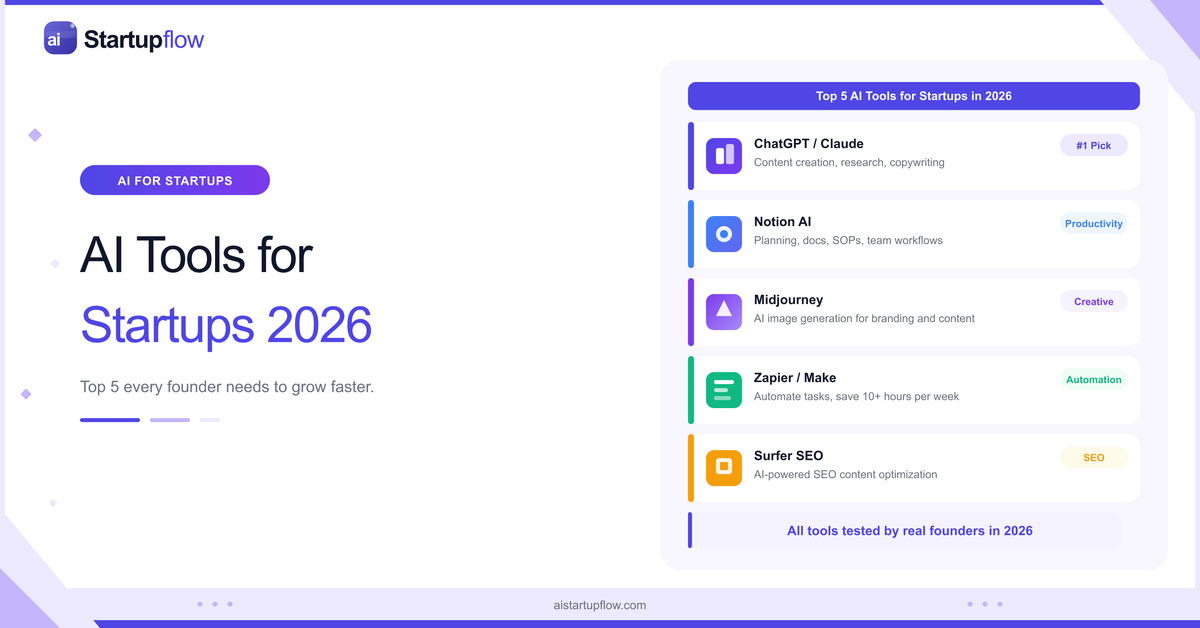
This guide cuts through it. Below are the top 5 AI tools every startup founder needs in 2026 — what they do, who they are for, and exactly what they cost.
Why Startups Need AI Tools in 2026
The startup landscape has shifted. Investors expect more traction with less capital. Customers expect faster responses, better content, and smoother experiences. And your competitors, even the scrappy ones, are already using AI to move faster than before.
AI tools for startups are no longer a nice-to-have. They are the operating system of a modern lean team.
According to G2’s 2026 Software Trends Report, startups that adopt AI tools in their first year are significantly more likely to hit product-market fit faster and reduce their burn rate compared to those that rely on manual processes alone.
The founders winning right now are not necessarily the ones with the biggest teams or the most funding. They are the ones who know which tools to use — and how to use them. If you are still figuring out your overall growth strategy, our guide on how to get website traffic breaks down the free channels that drive the most consistent results.
How We Picked These 5 AI Tools
Not every popular tool made this list. We filtered based on four criteria that matter most to early-stage founders:
- Time saved per week — Does it actually reduce your workload?
- Learning curve — Can a non-technical founder use it on day one?
- Cost vs. value — Is the ROI clear at the startup stage?
- Direct impact on growth — Does it help you acquire users, create content, or scale operations?
Every tool on this list passed all four filters.
1. ChatGPT / Claude Best for Content and Research
If you only adopt one AI tool for your startup, make it a conversational AI assistant. ChatGPT and Claude are the two best options in 2026 — and many founders use both.
These tools handle the kind of work that used to require a full-time employee: writing blog posts, drafting emails, researching competitors, summarizing documents, generating landing page copy, and answering complex business questions in seconds.
Key Features
Long-form content generation (blogs, emails, proposals, pitch decks)
Deep research and summarization of long documents
Code generation and debugging for technical founders
Brainstorming and ideation for product and marketing
Customer support script creation
Best Use Cases for Founders
Content marketing at scale: Write a week’s worth of social posts, email newsletters, or blog drafts in under an hour
Investor materials: Draft and refine pitch decks, executive summaries, and financial narratives
Customer research: Analyze feedback, reviews, and survey responses and extract key patterns
Competitive analysis: Research competitors quickly and summarize their positioning
Pricing
ChatGPT Plus and Claude Pro both start at $20/month — one of the best value-per-dollar investments in your startup stack. For most founders, either plan covers everyday content and research needs comfortably.
2. Notion AI Best for Planning and Productivity
Notion has been the go-to workspace tool for startups for years. Notion AI takes it to another level by embedding artificial intelligence directly into your docs, wikis, and project boards.
Instead of switching between your notes and a separate AI tool, Notion AI lets you ask questions, summarize meeting notes, generate SOPs, and draft content — all without leaving your workspace.
Key Features
AI-powered writing and editing inside your Notion docs
Automatic meeting note summarization
SOP and process documentation generation
Q&A across your entire Notion workspace
Task and project planning assistance
Best Use Cases for Founders
Onboarding new team members: Generate SOPs and training documents in minutes instead of days
Meeting summaries: Paste raw notes and get a clean, structured summary with action items
Product roadmap planning: Use AI to organize ideas, prioritize features, and document decisions
Knowledge base building: Turn scattered notes into organized, searchable company documentation
Pricing
Notion AI is included in the Business plan at $20/user/month. For solo founders, the Plus plan with a separate AI app like Claude or ChatGPT is a more cost-effective combination.
3. Midjourney Best for Visual Content and Branding
Most early-stage startups cannot afford a full-time designer. Midjourney solves this.
It is the leading AI image generation tool in 2026, producing high-quality, professional visuals from simple text prompts. Founders use it for everything from social media graphics and blog featured images to brand mood boards and pitch deck visuals.
The quality gap between Midjourney and other image tools is significant. If your startup’s visual presence matters and it does this is the tool to use.
Key Features
Text-to-image generation with industry-leading visual quality
Style customization for brand consistency
Multiple image variations from a single prompt
High-resolution outputs suitable for print and digital use
Commercial usage rights included on all paid plans
Best Use Cases for Founders
Social media content: Generate on-brand visuals for LinkedIn, Instagram, and Twitter in minutes
Blog featured images: Create custom header images for every blog post without a designer
Brand mood boards: Explore visual identity directions before committing to a brand style
Pitch deck visuals: Add professional, unique visuals to investor presentations
Pricing
Midjourney pricing starts at $10/month for the Basic plan with 3 hours of fast GPU time. The Standard plan at $30/month gives you 15 hours of fast generation — the best option for most startup founders who need regular visual content.
4. Zapier / Make Best for Automation
Every hour you spend on a repetitive task is an hour you are not spending on growth. Zapier and Make fix this by connecting your apps and automating workflows — no coding required.
Think of them as the glue between all your other tools. When a new lead fills out your form, Zapier automatically adds them to your CRM, sends a Slack notification, and triggers a welcome email all without you touching anything.
Key Features
Connect 6,000+ apps without writing a single line of code
Multi-step automation workflows (called Zaps or Scenarios)
Conditional logic for complex automation rules
Scheduled automations and trigger-based workflows
Built-in error handling and logging
Best Use Cases for Founders
Lead management: Automatically route new leads from forms to your CRM and notify your team
Social media scheduling: Auto-publish content across platforms when new blog posts go live
Customer onboarding: Trigger welcome emails, Slack messages, and task creation when a new user signs up
Reporting: Auto-generate and send weekly performance reports to your team or investors
Pricing
Zapier’s Starter plan is available at $19.99/month (billed annually), which includes multi-step Zaps and 750 tasks per month. The Professional plan at $49/month gives you 2,000 tasks and access to premium apps — the right choice for most growing startups.
Make (formerly Integromat) is a strong alternative with a more flexible pricing model, starting with a generous free tier and paid plans from around $9/month.
5. Surfer SEO Best for SEO Content Optimization
You can write great content and still rank nowhere if it is not optimized for search. Surfer SEO solves this by analyzing the top-ranking pages for any keyword and telling you exactly what your content needs to outrank them.
For startups trying to build organic traffic without an agency, Surfer SEO is one of the highest-ROI tools available. It removes the guesswork from SEO and replaces it with data. If you want to understand how SEO fits into your broader traffic strategy, our guide on how to get website traffic covers the full picture.
Key Features
Real-time content scoring based on top-ranking competitors
Keyword density and NLP recommendations
AI-generated content briefs and outlines
SERP analysis for any target keyword
Integration with Google Docs and WordPress
Best Use Cases for Founders
Blog post optimization: Score your drafts in real time and hit the targets needed to rank
Content briefs: Generate data-backed outlines before writing any piece of content
Competitor gap analysis: See exactly what top-ranking pages cover that yours does not
Content audits: Find existing pages that need updates to recover or improve their rankings
Pricing
Surfer SEO’s Essential plan costs $99/month (or $79/month billed annually), which includes 30 Content Editor articles, 5 AI-generated articles, and 100 page audits per month — the right starting point for most startup content teams.
How to Choose the Right AI Tools for Your Startup
You do not need all five tools on day one. Start with what solves your biggest immediate bottleneck.
If content is your constraint → Start with ChatGPT or Claude
If organization and planning slow you down → Add Notion AI
If you need visuals but have no designer → Get Midjourney
If repetitive tasks eat your week → Set up Zapier or Make
If organic traffic is your growth channel → Invest in Surfer SEO
Build your AI stack gradually. Each tool should pay for itself in time saved within the first month. If it does not, it is not the right tool for your current stage. And always pair your AI tools with a clear startup financial model so you can track your tool costs against the revenue and time savings they generate.
Conclusion
The best AI tools for startups are not the most expensive or the most complex. They are the ones that solve your real constraints right now — whether that is content, design, automation, SEO, or organization.
Start with one tool. Get comfortable with it. Measure the time it saves you. Then add the next one.
The founders who build the strongest AI stacks are not the ones who adopted everything at once. They are the ones who chose deliberately and built incrementally.
Want to make sure your AI tool spend is tracked properly in your financial model? Read our complete guide: Financial Model for Startup: A Simple Step-by-Step Guide